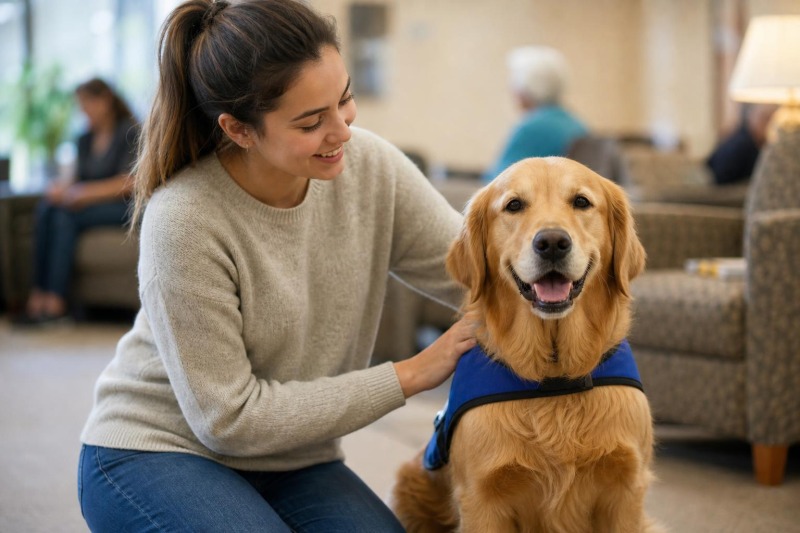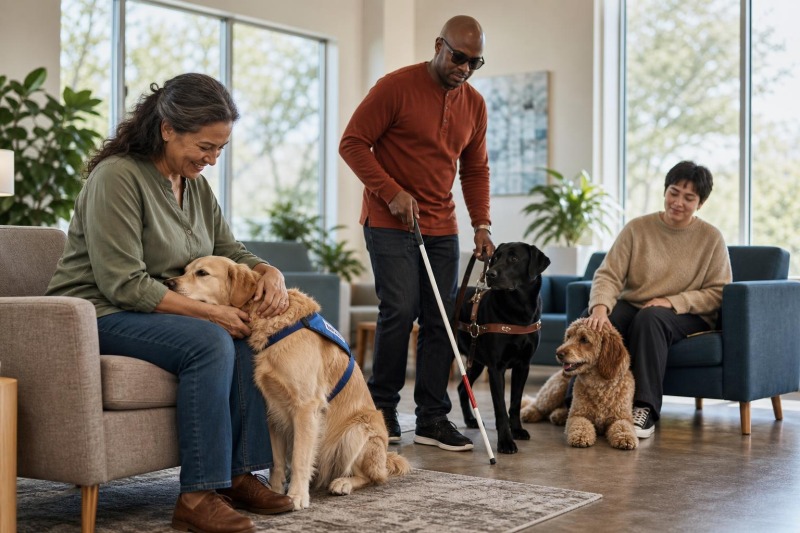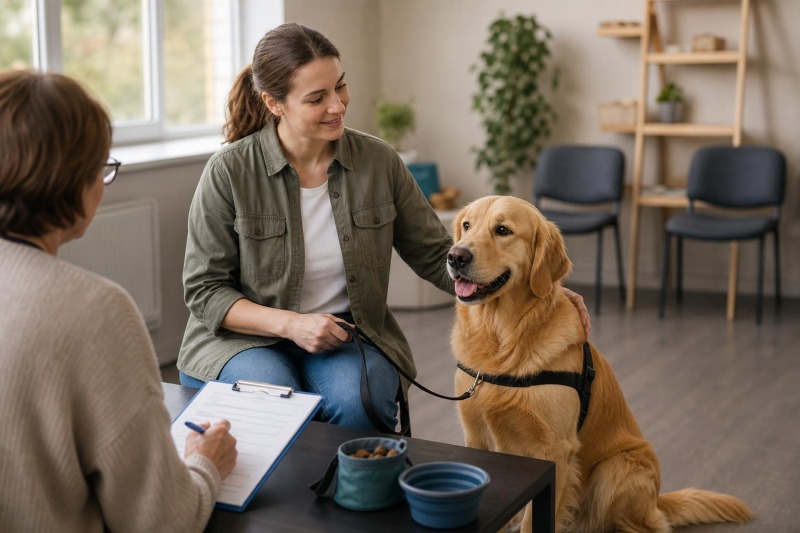
A therapy dog works with a handler to visit people in an agreed setting, such as a school or care facility. The visit should suit the people involved and remain comfortable for the dog.
Folks often hear the term and assume it means any dog that makes a person feel better. In a broad everyday sense, plenty of dogs do exactly that. But in the proper sense, a therapy dog is a well-mannered, stable, friendly dog trained and evaluated to visit people outside the home to offer comfort, companionship, and emotional relief. These dogs may spend time in hospitals, nursing homes, schools, rehab centers, disaster response settings, or counseling offices. Their work is not about guarding, retrieving, or guiding. Their work is about presence.
What Is a Therapy Dog?
A therapy dog is a dog that works with a handler to provide comfort and affection to other people, usually in organized settings. The key point is that the dog is there to help many people, not just one owner. A therapy dog may sit quietly while a child reads aloud in a school library, rest its head beside a hospital bed, or calmly greet residents in an assisted living center who may be hungry for touch, memory, and simple companionship.
That calm, steady nature is the heart of the job. A true therapy dog must be safe, predictable, and social. The dog should welcome gentle attention from strangers, recover quickly from surprises, and remain composed in unfamiliar environments. It is less about flashy obedience and more about reliability. You want a dog that can move through a room like a seasoned guide through thick timber, reading the ground, staying level, and never stirring up trouble.
In most cases, therapy dogs and their handlers volunteer through therapy dog organizations that test temperament, manners, and public behavior. Once approved, they visit approved facilities or events. That structure matters because therapy work brings dogs into contact with vulnerable people. A dog may be meeting seniors with limited mobility, children with developmental challenges, or patients dealing with pain, grief, or fear. Good intentions alone are not enough. The dog needs the right temperament, and the team needs proper standards.
What Does a Therapy Dog Do?
The day-to-day work of a therapy dog can look simple from the outside, but simple does not mean small. These dogs help create moments of ease. A patient waiting on test results may relax while stroking a dog’s ears. A child who is nervous about reading aloud may gain confidence with a dog stretched across the floor nearby, listening without judgment. A veteran in treatment may find it easier to open up when a dog breaks the tension in the room.
Therapy dogs do not diagnose, treat, or perform medical tasks. What they do is support the emotional atmosphere. They can reduce stress, encourage social interaction, and help people feel grounded. In some settings, that comfort helps people engage more fully in therapy, learning, or recovery. The dog becomes a bridge. Sometimes that bridge is quiet. Sometimes it is the difference between a person shutting down and a person staying present.
Common Places Therapy Dogs Work
You will often find therapy dogs in hospitals, nursing homes, assisted living communities, schools, libraries, colleges during exam weeks, rehabilitation centers, hospice programs, and mental health support settings. Some are invited to courtrooms to help calm children or anxious witnesses. Others may visit after community tragedies or natural disasters where people need a steady, gentle presence. The location can vary, but the mission stays about the same: offering comfort in places where people carry a heavy load.
Therapy Dog vs Service Dog: What Is the Difference?
This is where many people get turned around. A therapy dog is not the same as a service dog. The difference matters, both legally and practically.
A service dog is trained to perform specific tasks for a person with a disability. Those tasks might include guiding a blind handler, alerting to a seizure, retrieving dropped items, interrupting panic behaviors, or assisting with mobility. The service dog is there for one person and has legal access rights under disability law in many public places.
A therapy dog, on the other hand, is there to comfort other people. The therapy dog does not have the same broad public access rights as a service dog. Access is generally based on invitation or approval from the facility being visited. That distinction is important for owners, businesses, and the public to understand. A therapy dog may be incredibly valuable, but it is not a service dog unless it is individually trained to perform disability-related tasks for its handler.
Therapy Dog vs Emotional Support Dog vs Companion Dog
There is another layer of confusion because people also use terms like emotional support dog and companion dog. A companion dog is, in plain terms, a dog kept primarily for friendship and everyday life. That role is noble in its own right. A loyal companion can get a person through lonely seasons, hard winters, and long recoveries better than most people realize.
An emotional support dog provides comfort to its owner through its presence, but it is not the same as a therapy dog. Emotional support animals are meant for one individual and are not trained to visit facilities and interact with the public as therapy teams do. A therapy dog works outward. A companion dog or emotional support dog works inward, centered on the owner’s daily life and well-being.
So when someone asks, what is a therapy dog, the simplest good answer is this: it is a dog trained, tested, and welcomed into settings where it provides comfort to many people, usually alongside a handler.
What Makes a Good Therapy Dog?
Breed matters less than temperament. The best therapy dogs are calm without being dull, friendly without being pushy, and confident without being overbearing. They should tolerate strange noises, medical equipment, sudden movements, clumsy petting, and crowded spaces. A dog that startles easy, guards resources, or dislikes strangers is not suited for this job, no matter how loved it is at home.
Obedience is part of the picture, but emotional steadiness is the backbone. A dog should walk politely on leash, respond to cues, settle on command, and ignore distractions. More than that, the dog should genuinely enjoy human contact. Some dogs endure attention. Therapy dogs should welcome it. They need to be the kind of dogs that seem to understand when a hand lingers on their shoulder a little longer than usual.
Can Any Breed Become a Therapy Dog?
In theory, many breeds and mixed breeds can become therapy dogs if they have the right temperament, health, and training. Golden Retrievers, Labrador Retrievers, Poodles, Cavaliers, and well-balanced mixed breeds are common choices because they are often social and adaptable. But no breed gets a free pass. A dog’s individual temperament always comes first. Good therapy work is earned through testing, training, and consistency, not assumed by pedigree.
How Are Therapy Dogs Trained?
Training usually starts with strong basic manners. The dog should know how to sit, stay, come, walk calmly on leash, and remain polite around strangers and other dogs. From there, therapy-specific preparation often includes exposure to wheelchairs, walkers, loud hallways, elevators, dropped objects, unusual scents, and people who move or speak unpredictably. The goal is not to make the dog robotic. The goal is to make the dog steady.
Many handlers work through recognized therapy dog organizations that provide evaluations and registration. These groups often assess whether the dog can handle petting from unfamiliar people, remain calm in stimulating environments, and follow the handler’s direction. Some facilities also have their own requirements, health standards, and insurance expectations. A therapy team is not just a sweet dog and a willing owner. It is a partnership built on trust, preparation, and responsibility.
Who Benefits From Therapy Dogs?
The short answer is a wide range of people. Children learning to read, seniors in long-term care, patients in rehabilitation, people facing anxiety, students under stress, and individuals coping with grief can all benefit from therapy dog visits. Sometimes the benefit is emotional comfort. Sometimes it is motivation. Sometimes it is simply a bright point in a hard day.
It can be powerful. It can lower walls. It can bring a smile back to someone who has been shut in all morning with pain or worry. The therapy dog does not fix every problem, but it can make a person feel less alone while facing one.
Is a Therapy Dog Right for Your Dog?
Not every good dog is meant for therapy work, and that is perfectly fine. Some dogs are happiest as companion animals. Some are cut out for sport, farm work, or service tasks. Therapy work asks for a dog that truly enjoys meeting strangers and can stay composed in environments that are often busy, emotional, or unpredictable. It also asks something of the handler. You need patience, good judgment, and a real commitment to training and respectful visiting.
If your dog is healthy, social, calm, and obedient, therapy work may be worth exploring. Start with obedience training, honest temperament evaluation, and exposure to new settings. If your dog lights up around people and remains steady under pressure, you may have the foundation for something special.
A therapy dog is more than a friendly pet with a nice vest. It is a dog with the right temperament, training, and purpose, working alongside a handler to bring comfort where it is needed most. In a world that can feel rushed, sharp-edged, and lonely, that kind of work matters.
For anyone exploring the world of therapy dogs, service dogs, or companion dogs, it helps to start with the truth and keep the labels clear. A therapy dog serves many people. A service dog is trained for one person’s disability-related needs. A companion dog brings daily friendship into a home. Each role has value. But therapy dogs hold a special place because they walk into difficult spaces and, by simple steady presence, help folks breathe easier.