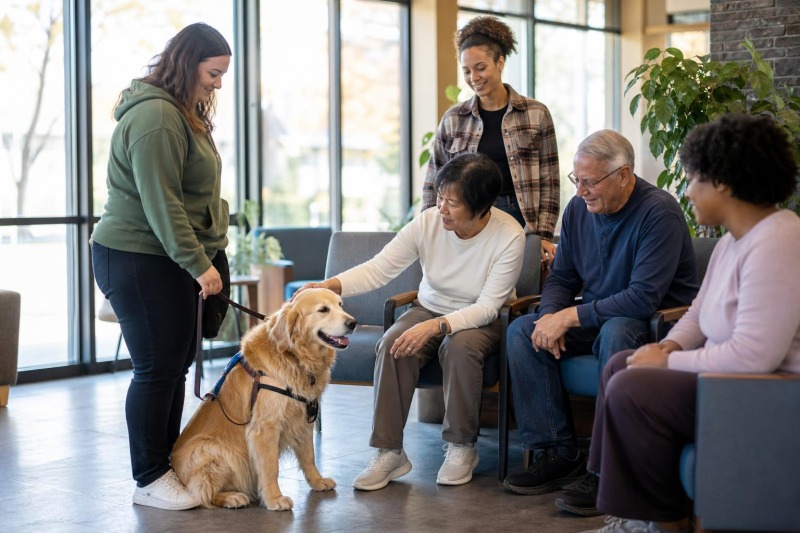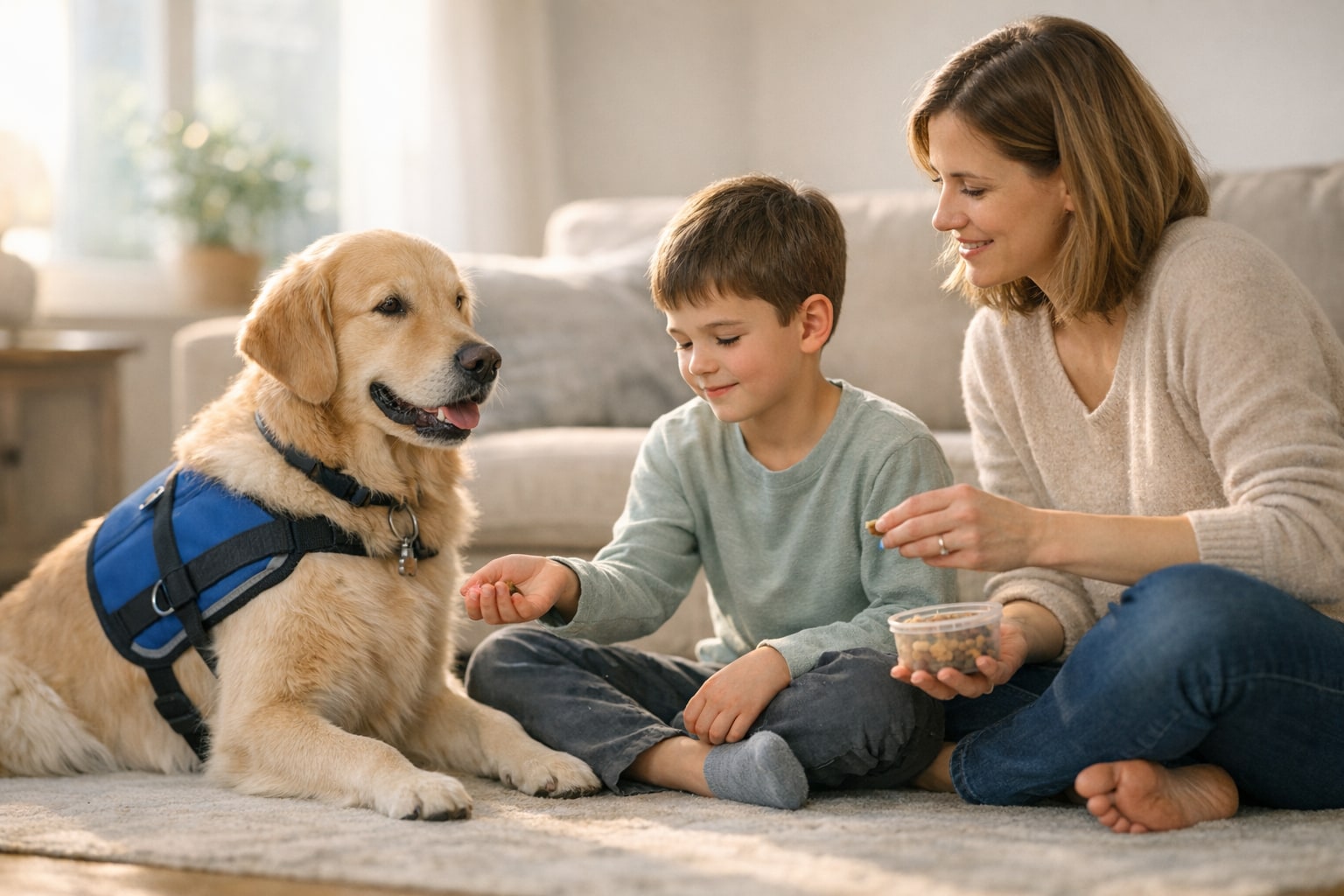
Dog training for autism support should begin with the individual person's needs and a safe, clearly defined role. Assess tasks and handling arrangements with appropriate professional support.
Folks often come to this subject thinking the answer is simply to find a friendly dog and teach a few commands. Truth is, the work runs deeper. An autism support dog may help reduce anxiety, interrupt repetitive behaviors, provide grounding during sensory overload, or bring a calming physical presence to everyday life. For some families, that dog becomes the steady center of camp, the one living creature in the house who notices trouble before anyone says a word.
What an Autism Support Dog Is Meant to Do
Before training begins, it helps to understand the role itself. Autism support dogs may serve in different ways depending on the individual. Some work more like companion or therapy dogs, offering comfort and emotional regulation. Others are trained as service dogs with specific task-based duties tied to a diagnosed disability. That distinction matters, because public access rights, training standards, and expectations differ.
In practical terms, the dog’s job is to create stability. That can mean lying across a person’s lap during a meltdown to provide deep pressure. It can mean leading a handler away from an overwhelming environment. It can mean interrupting self-harming or escalating repetitive behaviors with a nudge, a paw, or a trained redirection. In homes with children, the dog may also help with transitions, bedtime routines, or emotional settling after school. A well-prepared autism support dog is not a miracle cure, but it can become a reliable tool in a larger support system.
Choosing the Right Dog Comes Before Training
You cannot force the wrong temperament into this kind of work. A dog that startles easily, guards space, becomes frustrated under touch, or struggles in new environments is already carrying too much weight for a job built on steadiness.
The best candidates tend to be calm without being dull, attentive without being clingy, and social without being overexcited. They should recover quickly from surprise. If a dropped pan, sudden shouting, or crowded room sends a dog into orbit, that is not a small problem to train around. For autism support work, recovery matters as much as initial reaction. The dog does not need to be perfect. He needs to be resilient.
Breed can influence tendencies, though it never tells the whole story. Labrador Retrievers and Golden Retrievers are often chosen for a reason. They are generally biddable, stable, and people-oriented. Standard Poodles can also be strong candidates, especially for homes needing a lower-shedding coat. Even so, individual temperament always outranks breed reputation.
Why Early Socialization Matters So Much
A dog prepared for autism support must be able to move through the world without carrying every sound and sensation like burrs in his coat. Early socialization should expose the dog to busy sidewalks, waiting rooms, carts rolling by, doors slamming, children moving unpredictably, and a variety of surfaces underfoot. The goal is not to flood the dog with stress but to teach him that novelty does not equal danger.
Done well, socialization builds confidence. Done carelessly, it can create avoidance or fear. Like introducing a young hunting dog to the field, you do not want to burn out his mind by pushing too much too fast. You let confidence take root one experience at a time.
Foundational Training for Autism Support Work
Every advanced task sits on the shoulders of basic obedience and impulse control. A dog being trained for autism support should have solid responses to sit, down, stay, come, heel, place, and leave it. More important than flashy obedience is reliability in real life. Can the dog hold a down-stay while a child cries? Can he walk past another dog without pulling? Can he settle quietly in a waiting room for twenty minutes?
Settle training is one of the most valuable skills in this field. Families dealing with autism often need calm brought into the room, not more movement added to it. A dog that can tuck himself by a chair, under a table, or beside a bed and stay relaxed is worth his weight in gold. That kind of composure does not happen by accident. It comes from repeated practice in low-distraction settings before gradually adding noise, motion, and time.
Marker training and reward-based methods work especially well here because they create clarity. The dog learns exactly which behavior earns reinforcement. Harsh corrections may suppress behavior in the moment, but they can also create uncertainty or stress, and stress has no business being layered into support work. A dog that is meant to calm another person should not be trained in a way that frays his own nerves.
Task Training That Supports Daily Life
Once the foundation is in place, training becomes more personal. Deep pressure therapy is one common task. The dog learns to place part or all of his body across a handler’s lap, legs, or torso on cue and eventually in response to signs of distress. That pressure can be grounding and soothing, especially during sensory overload or anxiety spikes.
Another valuable task is interruption. Some dogs are trained to respond to repetitive motions, scratching, pacing, rocking, or other escalating behaviors by nudging the hand, resting the head against the leg, or performing another interrupt cue. The point is not to punish the behavior. The point is to offer a bridge back to regulation.
For handlers who struggle with transitions or crowded environments, the dog may learn to guide toward an exit, create space in a line, or lead to a familiar adult. In children, tethering and anti-wandering work are sometimes discussed, but this requires serious professional oversight. Safety must come first. A dog should never be used in a way that places too much physical burden on him or creates risk during sudden movement.
Training the Family, Not Just the Dog
One hard truth is that many promising dogs fail not because they lack heart, but because the household never learns how to handle them consistently. Autism support training works best when everyone in the home understands the dog’s cues, boundaries, schedule, and job. Mixed messages confuse the dog and weaken reliability.
Routine matters. Feeding at regular times, practicing commands in short sessions, rewarding calm behavior, and maintaining rest periods all help the dog stay balanced. Handlers also need to know when the dog is working and when he is simply being a dog. Even the finest support animal needs time to sniff the yard, chew a toy, sleep deeply, and let the world pass by without carrying anyone’s troubles for an hour.
That is where the real change often happens. The dog learns the family, and the family learns the dog. They begin reading each other like weather signs over an open field.
Public Access, Safety, and Realistic Expectations
If the dog is being trained as a service dog, public behavior standards are non-negotiable. He should ignore food on the floor, remain under control in stores or clinics, rest quietly when not actively working, and avoid soliciting attention. A dog that lunges, barks excessively, startles customers, or cannot settle in public is not yet ready for that responsibility.
It is also important to say plainly that not every autistic person wants or benefits from a support dog. Some may dislike the sensory feel of fur, movement, or licking. Others may find the responsibility too heavy. A support dog should be matched thoughtfully to the individual’s actual needs, not to an idealized picture of what a dog might represent.
Families should expect the process to take time. Training a dependable autism support dog can take many months and sometimes longer than a year, depending on the dog, the tasks, and the public access expectations involved. There is no shortcut around maturity. You can polish obedience, but emotional steadiness grows at its own pace.
When Professional Help Makes the Difference
There are times when bringing in a qualified service dog trainer or behavior professional is the smartest move on the map. If the dog shows fear, frustration, overstimulation, or inconsistent public behavior, expert guidance can save months of trouble. The same is true when training task work that must be legally and functionally sound. Good help does not just teach commands. It teaches standards.
Look for someone with experience in service dog development, disability-related task training, and family coaching. A trainer should be able to explain why a task is appropriate, how it will be proofed in different environments, and whether the dog’s temperament truly fits the work. Honest professionals will tell you when a dog is unsuitable, and that kind of honesty is worth paying for.
The Bond at the Center of the Work
The best ones do it without drama. They do it with a calm body, a watchful eye, and the kind of presence that lowers the temperature in the room. That sort of help cannot be faked with fancy gear or a vest bought online. It is earned through careful selection, patient training, and daily trust.
If you are considering an autism support dog, take the long view. Choose temperament over appearance. Build basics before advanced tasks. Respect the dog’s limits. And remember that a well-trained support dog is not just performing commands. He is becoming a dependable partner in the rough country of daily life, helping a person or family move through it with a little more calm, a little more confidence, and a lot less feeling alone.