
Service Dog Laws in the United States
What Every Dog Owner Should Know
Jeff Davis | https://companiondogcentral.com
 0
0 0
0 0
0 0
0 0
0
If you spend enough time around dogs, and especially if you have worked with them in the field, in the home, and around people who depend on them every day, you learn a simple truth: a good dog can change a life. I have seen dogs track through thick brush, sit steady through noise and confusion, and read a human being better than most folks ever will. Service dogs fall into that rare class of animal that is more than a pet and more than a companion. They are working dogs with a legal role, and in the United States, that role is protected by law.
Still, service dog laws in the United States are often misunderstood. Business owners get nervous. Dog owners hear bad advice. Families shopping for a dog or considering training one for disability support run into a mess of half-truths online. Some people assume any well-behaved dog with a vest is a service dog. Others think certification papers are required everywhere. Neither is quite right.
This article lays out the practical side of service dog laws, with the plainspoken clarity folks deserve. If you are learning about therapy dogs, companion dogs, or service dogs for the first time, this will help you get your footing.
What Is a Service Dog Under U.S. Law?
Under the Americans with Disabilities Act, often called the ADA, a service dog is a dog that has been individually trained to do work or perform tasks for a person with a disability. That definition matters because the law focuses on the dog’s training and the handler’s disability-related need, not on a fancy vest, registration card, or online certificate.
The task has to be directly related to the person’s disability. A service dog might guide a person who is blind, alert a person who is deaf, retrieve dropped items, assist with balance, interrupt psychiatric episodes, remind a handler to take medication, or detect a medical event such as a seizure or blood sugar change. The dog is not just there for comfort. The dog has a working function.
That line is where many people get tripped up. A dog that makes someone feel calmer, safer, or less lonely is valuable, no question about it, but comfort alone does not make a dog a service dog under the ADA.
Service Dogs, Therapy Dogs, and Companion Dogs Are Not the Same
This is one of the most important things for the public to understand. A service dog has legal public access rights under federal law when it is trained to perform disability-related tasks for its handler. A therapy dog, by contrast, usually works in places like hospitals, schools, nursing homes, or counseling settings to provide comfort to other people. A companion dog, sometimes called a pet dog or emotional support companion in casual conversation, provides affection and support in daily life but does not automatically receive the same legal access rights as a service dog.
That distinction matters in stores, restaurants, hotels, and housing situations. It also matters for the credibility of legitimate service dog teams. Folks who pass off an untrained pet as a service dog create confusion and make life harder for people who truly depend on these dogs.
The Americans with Disabilities Act and Public Access
The ADA is the main federal law most people are talking about when they ask where service dogs are allowed. In general, a person with a disability has the right to be accompanied by a service dog in areas where the public is normally allowed to go. That includes many businesses, government buildings, and public-facing spaces such as restaurants, stores, hotels, theaters, and medical offices.
There are limits, though they are narrower than some business owners think. A service dog can be excluded if the dog is out of control and the handler does not take effective action to control it, or if the dog is not housebroken. A business also does not have to allow a dog into a space where the dog’s presence would fundamentally alter the nature of the service being provided, though that is a high bar and not an excuse used lightly.
In plain terms, a true service dog should be steady, responsive, and mannerly in public. A dog lunging, barking through a meal, snapping at other customers, or relieving itself indoors is not acting like a trained working dog. Good training is not just a courtesy. It is part of what keeps public access workable for everyone.
What Businesses Are Allowed to Ask
When a disability is not obvious, staff may ask only two questions under the ADA. They may ask whether the dog is required because of a disability, and they may ask what work or task the dog has been trained to perform. They may not demand that the handler disclose a diagnosis. They may not require medical records. They may not insist on certification or special identification as a condition of entry.
That surprises a lot of people, especially in an age where scammers sell official-looking paperwork online. The law does not create a national service dog registry. Those websites often prey on confusion.
At the same time, handlers should not treat public access as a free pass to ignore standards. A serious service dog team knows that clean behavior, reliability, and respect for others are part of the job every time the dog leaves the house.
Housing Laws and Service Dogs
Housing is where legal questions often get more personal. A family may be moving into an apartment with a no-pets rule. A disabled tenant may need a service dog or other assistance animal and worry about being turned away. In many cases, the Fair Housing Act offers protections beyond what people expect.
Under fair housing rules, a housing provider may be required to make a reasonable accommodation for a person with a disability who needs an assistance animal. That can include a service dog and, in some cases, other support animals that do not qualify as service dogs under the ADA. This is one reason people get confused. The ADA and housing law do not always use the exact same framework.
Landlords generally cannot charge pet fees for a service dog required as an accommodation, though the tenant may still be responsible for damage actually caused by the animal. The request process may involve reliable documentation when the disability or need is not obvious, but it should not become a fishing expedition for private medical details.
If you are looking for a service dog, therapy dog, or companion dog, it is wise to learn the housing rules before signing a lease. A little homework can save a heap of trouble later.
Travel and Transportation Rules
Travel with a service dog used to stir up more confusion than a wind change in a deer stand. Some of that confusion still hangs around. Under current federal air travel rules, airlines generally recognize service dogs but are not required to treat emotional support animals the same way. Airlines may require specific forms attesting to the dog’s health, behavior, and training, especially for air travel.
That means a service dog handler should prepare ahead of time, not just assume airport rules mirror everyday store access. Buses, trains, and other public transportation systems also commonly allow service dogs under disability law, but handlers still need a dog that can work calmly in crowded, noisy, moving environments.
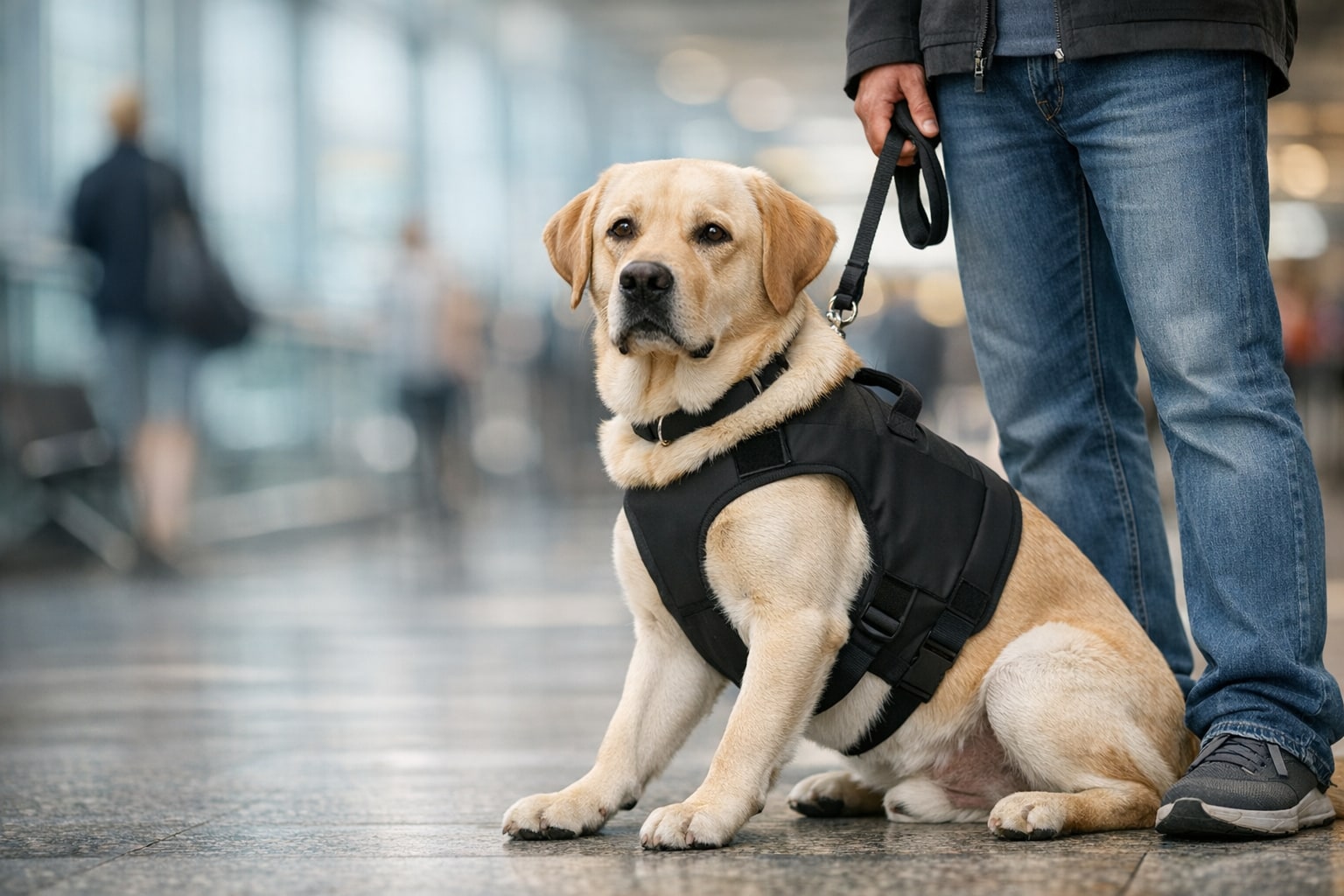
A dog may be rock solid in the living room and still not be ready for a terminal packed with rolling luggage, crying babies, food smells, and strangers reaching out with grabby hands. Training for the real world matters.
State Laws Can Add More Protection
Federal law sets the floor, not always the ceiling. Many states have their own service dog laws, and some of those laws provide extra protections or impose penalties for misrepresenting a pet as a service animal. State rules may also address service dogs in training, which the ADA does not cover in the same way for public access.
That is why it pays to check both federal law and your own state’s rules. A hunter learns early that terrain changes from one ridge to the next. Law works much the same way. The broad map matters, but the local ground under your boots matters too.
Do Service Dogs Need Certification or Registration?
In the United States, there is no single federal certification or registration required under the ADA for a service dog. A dog may be professionally trained or owner-trained. What matters is whether the dog is individually trained to perform disability-related tasks and whether it behaves appropriately in public.
That said, handlers often keep veterinary records, training logs, and other documentation for practical reasons. While those records are not a universal public access requirement, they can help in housing matters, travel planning, or resolving disputes. Just do not be fooled into thinking a purchased ID card from the internet creates legal status. It does not.
Why Honest Labels Matter
I have spent enough years around working dogs to know that titles should be earned. You would not call a green dog finished after one good day in the field, and you should not call a pet a service dog because it is convenient. A real service dog carries responsibility on its shoulders every day. The handler depends on that dog in ways that can affect safety, independence, and dignity.
When the public sees fake service dogs causing trouble, they become skeptical of every legitimate team that follows. That hurts disabled handlers first. It also muddies the conversation for families honestly trying to learn whether they need a service dog, a therapy dog, or simply a well-trained companion dog that makes life better at home.
What Prospective Dog Owners Should Remember
If you are thinking about bringing a dog into your life for support, start with your real needs. Do you need a dog trained for a specific disability-related task? Are you looking for a calm companion? Are you hoping to participate in therapy work that serves others? Those are different roads, and each one calls for different training, temperament, and legal understanding.
The best path is usually the honest one. Choose the dog role that fits your situation. Train thoroughly. Learn the laws before conflict finds you. And remember that the finest dogs, whether they serve in public or rest at your feet by the fire, are built on trust, steadiness, and clear purpose.
Service dog laws in the United States are not as mysterious as they first appear once you separate fact from noise. A service dog is a working dog trained to help a person with a disability. Federal laws protect that partnership, especially in public places, housing, and many forms of transportation. But those protections come with responsibilities, and understanding them helps everyone, from first-time dog owners to seasoned handlers.
At Companion Dog Central, that is the heart of the matter. Good information leads to better dogs, better choices, and better lives shared between people and the animals that stand by them.
Still, service dog laws in the United States are often misunderstood. Business owners get nervous. Dog owners hear bad advice. Families shopping for a dog or considering training one for disability support run into a mess of half-truths online. Some people assume any well-behaved dog with a vest is a service dog. Others think certification papers are required everywhere. Neither is quite right.
This article lays out the practical side of service dog laws, with the plainspoken clarity folks deserve. If you are learning about therapy dogs, companion dogs, or service dogs for the first time, this will help you get your footing.
What Is a Service Dog Under U.S. Law?
Under the Americans with Disabilities Act, often called the ADA, a service dog is a dog that has been individually trained to do work or perform tasks for a person with a disability. That definition matters because the law focuses on the dog’s training and the handler’s disability-related need, not on a fancy vest, registration card, or online certificate.
The task has to be directly related to the person’s disability. A service dog might guide a person who is blind, alert a person who is deaf, retrieve dropped items, assist with balance, interrupt psychiatric episodes, remind a handler to take medication, or detect a medical event such as a seizure or blood sugar change. The dog is not just there for comfort. The dog has a working function.
That line is where many people get tripped up. A dog that makes someone feel calmer, safer, or less lonely is valuable, no question about it, but comfort alone does not make a dog a service dog under the ADA.
Service Dogs, Therapy Dogs, and Companion Dogs Are Not the Same
This is one of the most important things for the public to understand. A service dog has legal public access rights under federal law when it is trained to perform disability-related tasks for its handler. A therapy dog, by contrast, usually works in places like hospitals, schools, nursing homes, or counseling settings to provide comfort to other people. A companion dog, sometimes called a pet dog or emotional support companion in casual conversation, provides affection and support in daily life but does not automatically receive the same legal access rights as a service dog.
That distinction matters in stores, restaurants, hotels, and housing situations. It also matters for the credibility of legitimate service dog teams. Folks who pass off an untrained pet as a service dog create confusion and make life harder for people who truly depend on these dogs.
The Americans with Disabilities Act and Public Access
The ADA is the main federal law most people are talking about when they ask where service dogs are allowed. In general, a person with a disability has the right to be accompanied by a service dog in areas where the public is normally allowed to go. That includes many businesses, government buildings, and public-facing spaces such as restaurants, stores, hotels, theaters, and medical offices.
There are limits, though they are narrower than some business owners think. A service dog can be excluded if the dog is out of control and the handler does not take effective action to control it, or if the dog is not housebroken. A business also does not have to allow a dog into a space where the dog’s presence would fundamentally alter the nature of the service being provided, though that is a high bar and not an excuse used lightly.
In plain terms, a true service dog should be steady, responsive, and mannerly in public. A dog lunging, barking through a meal, snapping at other customers, or relieving itself indoors is not acting like a trained working dog. Good training is not just a courtesy. It is part of what keeps public access workable for everyone.
What Businesses Are Allowed to Ask
When a disability is not obvious, staff may ask only two questions under the ADA. They may ask whether the dog is required because of a disability, and they may ask what work or task the dog has been trained to perform. They may not demand that the handler disclose a diagnosis. They may not require medical records. They may not insist on certification or special identification as a condition of entry.
That surprises a lot of people, especially in an age where scammers sell official-looking paperwork online. The law does not create a national service dog registry. Those websites often prey on confusion.
At the same time, handlers should not treat public access as a free pass to ignore standards. A serious service dog team knows that clean behavior, reliability, and respect for others are part of the job every time the dog leaves the house.
Housing Laws and Service Dogs
Housing is where legal questions often get more personal. A family may be moving into an apartment with a no-pets rule. A disabled tenant may need a service dog or other assistance animal and worry about being turned away. In many cases, the Fair Housing Act offers protections beyond what people expect.
Under fair housing rules, a housing provider may be required to make a reasonable accommodation for a person with a disability who needs an assistance animal. That can include a service dog and, in some cases, other support animals that do not qualify as service dogs under the ADA. This is one reason people get confused. The ADA and housing law do not always use the exact same framework.
Landlords generally cannot charge pet fees for a service dog required as an accommodation, though the tenant may still be responsible for damage actually caused by the animal. The request process may involve reliable documentation when the disability or need is not obvious, but it should not become a fishing expedition for private medical details.
If you are looking for a service dog, therapy dog, or companion dog, it is wise to learn the housing rules before signing a lease. A little homework can save a heap of trouble later.
Travel and Transportation Rules
Travel with a service dog used to stir up more confusion than a wind change in a deer stand. Some of that confusion still hangs around. Under current federal air travel rules, airlines generally recognize service dogs but are not required to treat emotional support animals the same way. Airlines may require specific forms attesting to the dog’s health, behavior, and training, especially for air travel.
That means a service dog handler should prepare ahead of time, not just assume airport rules mirror everyday store access. Buses, trains, and other public transportation systems also commonly allow service dogs under disability law, but handlers still need a dog that can work calmly in crowded, noisy, moving environments.
A dog may be rock solid in the living room and still not be ready for a terminal packed with rolling luggage, crying babies, food smells, and strangers reaching out with grabby hands. Training for the real world matters.
State Laws Can Add More Protection
Federal law sets the floor, not always the ceiling. Many states have their own service dog laws, and some of those laws provide extra protections or impose penalties for misrepresenting a pet as a service animal. State rules may also address service dogs in training, which the ADA does not cover in the same way for public access.
That is why it pays to check both federal law and your own state’s rules. A hunter learns early that terrain changes from one ridge to the next. Law works much the same way. The broad map matters, but the local ground under your boots matters too.
Do Service Dogs Need Certification or Registration?
In the United States, there is no single federal certification or registration required under the ADA for a service dog. A dog may be professionally trained or owner-trained. What matters is whether the dog is individually trained to perform disability-related tasks and whether it behaves appropriately in public.
That said, handlers often keep veterinary records, training logs, and other documentation for practical reasons. While those records are not a universal public access requirement, they can help in housing matters, travel planning, or resolving disputes. Just do not be fooled into thinking a purchased ID card from the internet creates legal status. It does not.
Why Honest Labels Matter
I have spent enough years around working dogs to know that titles should be earned. You would not call a green dog finished after one good day in the field, and you should not call a pet a service dog because it is convenient. A real service dog carries responsibility on its shoulders every day. The handler depends on that dog in ways that can affect safety, independence, and dignity.
When the public sees fake service dogs causing trouble, they become skeptical of every legitimate team that follows. That hurts disabled handlers first. It also muddies the conversation for families honestly trying to learn whether they need a service dog, a therapy dog, or simply a well-trained companion dog that makes life better at home.
What Prospective Dog Owners Should Remember
If you are thinking about bringing a dog into your life for support, start with your real needs. Do you need a dog trained for a specific disability-related task? Are you looking for a calm companion? Are you hoping to participate in therapy work that serves others? Those are different roads, and each one calls for different training, temperament, and legal understanding.
The best path is usually the honest one. Choose the dog role that fits your situation. Train thoroughly. Learn the laws before conflict finds you. And remember that the finest dogs, whether they serve in public or rest at your feet by the fire, are built on trust, steadiness, and clear purpose.
Service dog laws in the United States are not as mysterious as they first appear once you separate fact from noise. A service dog is a working dog trained to help a person with a disability. Federal laws protect that partnership, especially in public places, housing, and many forms of transportation. But those protections come with responsibilities, and understanding them helps everyone, from first-time dog owners to seasoned handlers.
At Companion Dog Central, that is the heart of the matter. Good information leads to better dogs, better choices, and better lives shared between people and the animals that stand by them.



View all 0 comments